
Steep slope roofing jobs carry a hidden tax that compounds with every project. The time lost to inefficient material handling, inadequate safety setups, and reactive problem-solving doesn’t just delay completion—it creates a systematic drain on profitability that most contractors drastically underestimate.
The roofing industry faces a critical inefficiency paradox: the projects with the highest risk profiles consistently suffer from the poorest operational systems. Contractors applying the same workflows to 8:12 pitches that they use on 4:12 slopes inevitably watch labor hours balloon, safety incidents multiply, and profit margins evaporate. This inefficiency compounds across every steep slope project, transforming what should be premium-priced work into break-even endeavors. Implementing proven efficiency systems from specialized shingle anchor solutions fundamentally changes this equation.
The solution requires abandoning reactive approaches in favor of systematic optimization. By addressing safety systems, material logistics, crew training, and technology integration as interconnected components rather than isolated fixes, contractors consistently achieve 30-45% reductions in project duration while simultaneously improving safety outcomes and crew morale.
Steep Slope Efficiency Essentials
Steep slope projects demand specialized systems that address safety, logistics, and productivity as integrated challenges. The contractors achieving superior results share common approaches: they invest in continuous tie-off safety systems that eliminate reconnection delays, implement material staging strategies that reduce handling time by 40%, deploy crew-specific training protocols for different pitch ranges, and track granular productivity metrics to identify compound inefficiencies. The payback period for systematic efficiency investments averages 8-12 projects, with ongoing productivity gains of 25-35% compared to reactive approaches.
Understanding the Real Cost of Steep Slope Inefficiencies
The true cost of steep slope inefficiency extends far beyond obvious labor overruns. Hidden productivity drains accumulate throughout every phase of execution, creating cascading delays that affect material delivery timing, crew scheduling, and subsequent project starts. When a steep slope job runs two days over estimate, the ripple effect impacts three to four downstream projects.
Most contractors track only direct labor hours, missing the substantial time consumed by safety equipment setup and breakdown, material shuttling between ground and installation points, and the constant interruptions caused by inadequate staging systems. A comprehensive time study across typical steep slope projects reveals that productive installation time represents only 45-55% of total on-site hours, with the remainder lost to logistics, safety procedures, and weather delays.
The financial impact becomes stark when calculated across annual project volume. A crew averaging three steep slope projects monthly, with each job experiencing just 90 minutes of daily inefficiency, loses approximately 540 hours annually—equivalent to eliminating one full crew member’s productive capacity. At average labor rates including burden, this represents $25,000-35,000 in pure waste before accounting for delayed revenue recognition and opportunity costs.
OSHA Steep Slope Safety Violations Impact
In 2024, roofing contractors faced massive penalties for steep slope safety violations, with 110 fatal injuries from falls in 2023 alone. Companies like ALJ Home Improvement were cited for multiple employees working on steep slopes without fall protection, resulting in significant fines and project delays that directly impacted productivity and profitability.
Beyond immediate safety concerns, violations trigger inspection protocols that halt work entirely, often for multiple days while corrective measures are implemented and documented. The compounding effect of a single safety citation can eliminate profit across an entire quarter of steep slope work.
The productivity impact of inadequate systems manifests most clearly through crew utilization rates. On slopes exceeding 6:12 pitch, crews without systematic efficiency protocols experience utilization rates of 40-50%, meaning skilled installers spend half their time on non-productive activities. This metric alone explains why steep slope bids frequently underperform despite seemingly adequate contingencies.
Key Productivity Metrics to Track
- Measure actual labor hours versus estimated hours per square on steep slopes
- Track material handling time from ground to installation point
- Document safety equipment setup and breakdown times daily
- Calculate percentage of productive versus non-productive time
- Monitor crew utilization rates across different roof pitches
Implementing systematic tracking reveals patterns invisible to conventional project management. Contractors discover that material handling consumes 25-30% of steep slope labor hours, that safety setup inefficiencies cost 15-20 minutes per crew member daily, and that pitch-specific training gaps reduce installation speed by 20-35% compared to properly prepared crews.
Essential Safety Systems That Actually Save Time
The conventional wisdom positioning safety and efficiency as competing priorities fundamentally misunderstands modern fall protection systems. Advanced safety equipment specifically designed for steep slope applications simultaneously reduces risk and eliminates the productivity drains inherent in outdated approaches.
Traditional safety methods requiring constant disconnection and reconnection create dangerous gaps in protection while consuming substantial productive time. Workers ascending and descending steep slopes repeatedly disconnect from anchor points, reposition equipment, and reconnect—a cycle that introduces both fall hazards and workflow interruptions averaging 8-12 instances per hour.
Modern continuous tie-off systems eliminate this productivity drain entirely. Workers remain connected throughout the entire work sequence, moving freely across the roof surface without interruption. The time savings prove substantial: continuous tie-off systems eliminate reconnection delays that previously consumed 45-60 minutes of daily crew time on typical steep slope projects.
The implementation of proper ridge anchor systems exemplifies how advanced safety equipment transforms steep slope workflows. These specialized anchors install quickly, provide reliable protection across the entire roof plane, and remain in place throughout the project without interfering with material staging or installation sequences.

The precision engineering of contemporary anchor systems allows single-person installation in under 10 minutes, compared to 30-45 minutes for traditional methods requiring multiple workers. The anchor points accommodate horizontal lifeline systems that enable unrestricted movement across large roof sections, eliminating the constant repositioning that fragmented older safety approaches.
Horizontal lifeline systems integrated with quality anchor points create protected work zones spanning entire roof faces. Crews work continuously within these zones without equipment adjustments, maintaining installation rhythm and focus. The productivity impact equals or exceeds the time savings from eliminating disconnection cycles, as workers maintain consistent positioning and tool access.
| Equipment Type | Initial Cost | Time Saved/Day | Payback Period |
|---|---|---|---|
| Ridge Anchor System | $489 | 45-60 minutes | 5-7 jobs |
| Roof Brackets | $150-200 | 20-30 minutes | 8-10 jobs |
| Horizontal Lifeline | $800-1000 | 60-90 minutes | 10-12 jobs |
| Pitch Hopper | $300-400 | 30-40 minutes | 6-8 jobs |
The ROI calculation for safety equipment investments remains straightforward when time savings receive proper weighting alongside risk reduction. A ridge anchor system costing $489 that saves 50 minutes daily across a crew of three workers generates approximately $75-95 in recovered labor value per project day. With typical steep slope projects spanning 3-5 days, the equipment pays for itself within 5-7 jobs while simultaneously reducing insurance exposure and OSHA liability.
Strategic integration of complementary safety systems compounds these benefits. Roof brackets providing stable staging platforms reduce material handling time while improving fall protection. Pitch hoppers enable controlled material delivery to steep sections without repeated climbing. Each system addresses both safety and efficiency, with combined implementations achieving the 45-60 minute daily savings that separate profitable steep slope operations from marginal ones.
The connection between advanced safety equipment and broader operational efficiency extends to crew confidence and fatigue management. Workers equipped with reliable, unobtrusive protection systems maintain better focus on installation quality and demonstrate measurably lower fatigue levels at day’s end. This translates to fewer errors, reduced rework, and better retention of skilled workers who recognize employers investing in their safety and success. Parallels exist with comprehensive workplace safety equipment strategies across construction trades.
Material Handling Strategies for Maximum Efficiency
Material logistics represent the largest untapped efficiency opportunity in steep slope roofing. The vertical distance and awkward angles inherent to steep work create material handling challenges that consume 25-35% of total labor hours when addressed reactively. Systematic staging and delivery protocols reduce this burden by half while improving safety and reducing material damage.
The fundamental principle underlying efficient steep slope material handling involves minimizing the number of times any component gets touched between delivery and installation. Each additional handling instance consumes time, increases damage risk, and creates opportunities for positioning errors that cascade into installation delays.
Optimal material flow begins with delivery truck positioning and unloading sequences coordinated with roof access points and staging locations. Rather than creating a single ground-level staging area, efficient systems establish multiple staging zones at different elevations, moving materials progressively upward in batches that correspond to installation sequences.
Mechanical lifting systems tailored to steep slope applications eliminate the most physically demanding and time-consuming aspect of material handling. Roof conveyors, electric hoists, and specialized lifts move bundles from ground to roof plane in minutes rather than the hours required for manual carrying. A three-person crew manually shuttling 35 squares of shingles to a steep roof consumes approximately 4-5 hours; a conveyor system completes the same task in 45-60 minutes with a single operator.
The equipment investment required for mechanical material handling varies widely based on typical project scale and frequency. Contractors running multiple steep slope projects monthly justify dedicated roof conveyor systems ($3,000-5,000) that pay for themselves within 8-12 jobs. Operations with occasional steep work achieve similar efficiency gains through rental equipment or partnerships with material suppliers offering delivery-to-roof services.
Strategic staging on the roof surface itself proves equally critical to maintaining installation workflow. Rather than creating a single material pile requiring repeated repositioning, efficient protocols establish distributed staging zones aligned with installation progression. Shingle bundles stage along ridge lines in quantities matching 2-3 hours of installation, with replenishment occurring during natural workflow breaks rather than interrupting active installation.
Gravity-assisted material positioning leverages steep slope geometry to reduce handling effort. Materials staged slightly upslope from installation points allow controlled downward movement as work progresses, eliminating the uphill material shuttling that creates the greatest physical burden and time consumption. This approach requires careful planning to prevent uncontrolled sliding while enabling efficient material flow.
Specialized material handling equipment designed specifically for steep applications addresses unique challenges while improving safety. Pitch hoppers with controlled release mechanisms deliver shingles directly to installers without manual carrying. Roof brackets with integrated material shelves provide stable staging immediately adjacent to work areas. Magnetic strips and specialized bags keep fasteners, tools, and components secure on steep surfaces, eliminating the time lost to dropped items and retrieval efforts.
The compound effect of systematic material handling optimization extends beyond direct time savings. Reduced physical strain on crew members decreases fatigue, maintains installation quality throughout full workdays, and reduces injury risk from repetitive carrying on unstable surfaces. Crews working with efficient material systems demonstrate 15-20% higher productivity in final installation hours compared to those spending morning energy on material shuttling.
Technology and Tools Transforming Steep Slope Work
Digital tools and advanced equipment are fundamentally reshaping steep slope roofing economics by addressing the information gaps and physical limitations that have historically driven inefficiency. The integration of measurement technology, project management software, and specialized power tools creates compound improvements across estimating accuracy, material optimization, and installation speed.
Aerial measurement platforms using satellite imagery and drone technology eliminate the time, cost, and risk associated with manual steep roof measurements. These systems deliver accuracy within 1-2% while generating detailed reports in minutes rather than the hours required for traditional methods. The improved precision reduces material waste averaging 8-12% on steep projects while eliminating pre-project roof access that exposed estimators to fall risks.
Building Information Modeling (BIM) adapted for roofing applications enables virtual project planning that identifies material requirements, crew movements, and staging logistics before work begins. Contractors visualize optimal workflows, identify potential bottlenecks, and develop mitigation strategies during planning phases rather than discovering problems during expensive on-site execution. The planning efficiency gained through BIM reduces project duration by 10-15% while improving material utilization and crew coordination.
The technological transformation of steep slope work extends to installation equipment itself, with cordless power tools specifically engineered for roofing applications addressing the unique demands of steep work environments.
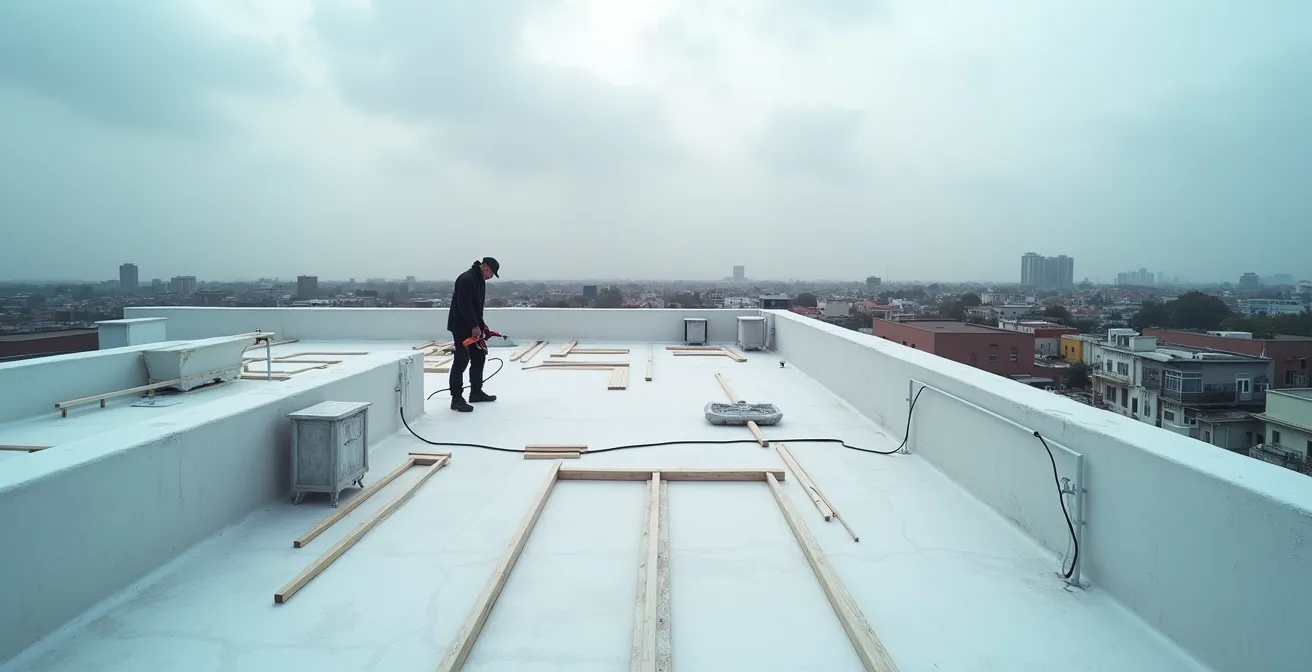
Modern roofing nailers combine lightweight construction with precise depth control and consistent firing performance across varying temperatures and slopes. These tools enable installers to maintain proper body positioning on steep surfaces while achieving installation speeds 25-30% faster than previous-generation equipment. Battery technology improvements now support full-day operation without mid-project charging interruptions that previously fragmented workflow.
Smart tool integration with project management platforms creates real-time productivity tracking and quality verification. Nail guns equipped with sensors record fastener placement, pressure, and spacing, generating installation data that verifies specification compliance while identifying productivity patterns. This granular information reveals crew-specific efficiency variations, training opportunities, and equipment maintenance needs invisible to conventional oversight.
Weather monitoring technology specifically calibrated for roofing operations provides predictive intelligence that optimizes scheduling and protects work quality. Advanced systems track not just precipitation probability but wind speeds, temperature trends, and humidity levels that affect material performance and installation conditions. Contractors access hour-by-hour forecasts enabling precise decisions about work windows, material staging timing, and crew deployment.
Mobile applications consolidating project documentation, safety checklists, and communication protocols reduce the administrative burden that consumes surprising amounts of steep slope project time. Foremen complete safety inspections, material orders, and progress documentation through tablet interfaces rather than paper systems requiring office processing. The time savings average 20-30 minutes daily while improving documentation quality and regulatory compliance.
The strategic implementation of these technologies requires matching tools to specific operational needs rather than pursuing technology for its own sake. Small to mid-sized contractors achieve optimal returns by prioritizing aerial measurement systems and mobile project management before investing in advanced BIM platforms that deliver value primarily at larger scale. The key lies in identifying which inefficiencies impose the greatest cost in specific operations, then deploying technology addressing those precise challenges.
Crew Training and Productivity Optimization
Crew capability represents the ultimate determinant of steep slope efficiency, with training quality creating performance gaps exceeding 40% between comparably equipped teams. The physical demands, technical requirements, and safety complexities of steep work require specialized preparation that generic roofing training fails to address.
Effective steep slope training programs differentiate instruction by pitch ranges, recognizing that techniques effective on 6:12 slopes prove inadequate or dangerous on 10:12 surfaces. Crews learn pitch-specific body positioning, tool handling, and movement patterns that maintain safety while optimizing installation speed. This specialized preparation reduces the adaptation time and error rates that plague crews transitioning from moderate to steep applications.
The progression model for steep slope skill development emphasizes graduated exposure rather than immediate deployment to the most challenging applications. New workers begin on moderate pitches while building core skills, then advance to steeper work as competency and confidence develop. This approach reduces both safety incidents and the productivity losses associated with inexperienced workers struggling with unfamiliar demands.
Hands-on training with actual safety equipment proves essential for developing the muscle memory and confidence required for efficient steep slope work. Classroom instruction and video demonstrations cannot replicate the physical experience of working on steep surfaces while managing fall protection equipment. Contractors investing in dedicated training time with equipment see 30-35% faster crew adaptation and measurably better safety compliance compared to learn-as-you-go approaches.
Cross-training crew members on multiple steep slope roles creates operational flexibility that prevents bottlenecks when absences or injuries affect crew composition. Workers capable of performing material handling, installation, and safety equipment management enable dynamic task allocation responding to real-time project conditions. This flexibility proves particularly valuable on steep work where specialized roles create dependencies that can stall entire crews when single workers are unavailable.
Ongoing skill development through regular training updates maintains competency while introducing new techniques, equipment, and best practices. The roofing industry evolves continuously, with improved methods and materials emerging regularly. Annual or semi-annual training sessions ensure crews benefit from these advances rather than perpetuating outdated approaches that compound inefficiency.
Performance feedback systems linking individual productivity to compensation create powerful incentives for continuous improvement. Crews tracking their own efficiency metrics develop ownership of productivity outcomes and actively seek optimization opportunities. This engagement transforms efficiency from a management initiative into a crew-driven culture where workers identify and solve inefficiency challenges affecting their daily experience.
The retention benefits of comprehensive training programs extend beyond immediate productivity gains. Skilled workers recognize and value employers investing in their development, reducing turnover that forces constant retraining and maintains perpetually inexperienced crews. The compounding effect of stable, well-trained crews creates sustained competitive advantages that manifest across estimating accuracy, project execution, and customer satisfaction.
Mentorship structures pairing experienced steep slope specialists with developing workers accelerate skill transfer while building team cohesion. Formal mentorship programs with defined skill progression criteria prevent the inconsistent knowledge transfer typical of informal apprenticeship approaches. The structure ensures all crew members achieve baseline competency while identifying high performers suitable for leadership development. These workforce development strategies align with broader business success strategies in skilled trades.
Weather Planning and Schedule Optimization
Weather represents the wild card in steep slope efficiency, with precipitation, temperature extremes, and wind conditions creating disruptions that cascade through project schedules and profitability. Sophisticated weather planning transforms this challenge from a reactive problem into a manageable variable through predictive scheduling and adaptive protocols.
The fundamental shift required involves moving from daily weather checks to continuous forecast monitoring throughout project duration. Modern weather services provide hourly forecasts extending 10-14 days with increasing accuracy, enabling strategic decisions about project starts, crew deployment, and material staging that minimize weather-related disruptions.
Micro-scheduling based on hour-by-hour weather windows maximizes productive time during variable conditions. Rather than calling off entire days when afternoon storms threaten, crews focus intensive work during protected morning hours, then transition to ground-level tasks or alternative projects when conditions deteriorate. This approach requires detailed task segmentation and mobile crew deployment but typically recovers 20-30% of time lost to conventional whole-day weather calls.
Strategic project sequencing aligns steep slope work with seasonal weather patterns specific to regional climates. Contractors in areas with predictable summer afternoon thunderstorms schedule steep work for morning-heavy sequences, reserving afternoon hours for interior work, material preparation, or less weather-sensitive applications. This rhythm matching eliminates the stop-start inefficiency of fighting predictable weather patterns.
Material staging protocols adapted to weather forecasts prevent the costly delays associated with wet or temperature-compromised materials. Shingles staged during unexpected temperature spikes become difficult to handle and install properly. Sophisticated operations monitor forecast temperatures and adjust staging timing to maintain materials within optimal handling ranges, preventing the installation delays and quality issues arising from improper material conditioning.
Wind speed monitoring proves particularly critical for steep slope safety and efficiency. Wind effects amplify with increasing slope and elevation, creating dangerous conditions well before ground-level observations suggest problems. Contractors implementing roof-level wind monitoring with defined shutdown thresholds protect crew safety while avoiding the opposite problem of excessive caution that sacrifices productive time during acceptable conditions.
Temperature-based installation windows for specific roofing materials require careful planning to maximize productivity while ensuring proper application. Many materials specify minimum and maximum installation temperatures, creating seasonal constraints that compress available work windows. Efficient operations build detailed calendars mapping material-specific temperature ranges against historical weather data, enabling strategic project scheduling that maximizes suitable installation days.
Contingency scheduling with pre-planned alternative tasks for weather-disrupted days prevents the total productivity loss typical of reactive approaches. Crews arriving to rained-out steep slope projects immediately transition to shop work, equipment maintenance, ground-level tasks, or alternative projects rather than losing entire days. This requires advance planning and task inventory management but transforms weather delays from complete losses into partial productivity days.
The integration of weather planning with broader project management systems creates automated alerts and decision support that reduces the management burden of continuous monitoring. Software platforms track forecasts, compare conditions against project-specific thresholds, and generate recommendations for schedule adjustments, crew deployment, and material staging. This automation prevents the oversights that occur when weather monitoring depends on manual attention amid competing demands.
Key Takeaways
- Systematic efficiency gains on steep slopes require integrated approaches addressing safety, logistics, training, and technology rather than isolated fixes
- Continuous tie-off safety systems eliminate 45-60 minutes of daily reconnection time while improving protection compared to traditional methods
- Material handling optimization through mechanical systems and strategic staging reduces labor consumption by 40-50% on typical steep slope projects
- Pitch-specific crew training creates productivity improvements of 30-40% compared to generic roofing preparation
- Weather planning with predictive scheduling and micro-windows recovers 20-30% of time typically lost to precipitation and temperature constraints
Measuring and Improving Your Steep Slope ROI
Profitability in steep slope roofing ultimately depends on systematic measurement and continuous improvement of the efficiency factors that separate successful operations from struggling ones. The contractors achieving superior returns implement formal tracking systems that quantify productivity, identify improvement opportunities, and validate the ROI of efficiency investments.
Comprehensive steep slope metrics begin with granular time tracking that segments projects into distinct phases: mobilization, safety setup, material handling, installation, cleanup, and demobilization. This detailed breakdown reveals which phases consume disproportionate time relative to value creation, directing improvement efforts toward highest-impact opportunities. Most contractors discover that non-installation phases consume 40-50% of steep slope labor hours, representing the primary efficiency improvement target.
Labor productivity metrics specific to steep work require normalization by pitch to enable meaningful comparison across projects. A crew installing 12 squares daily on 4:12 slopes may achieve only 6-7 squares on 10:12 work due to legitimate physical constraints. Tracking squares-per-day without pitch adjustment creates false performance signals that distort improvement efforts. Proper metrics account for pitch, generating productivity bands that identify genuine efficiency variations from expected performance ranges.
Material utilization tracking quantifies waste rates that directly impact steep slope profitability. The awkward handling and cutting required on steep surfaces typically increases waste 15-25% compared to moderate slopes. Systematic measurement of actual versus theoretical material consumption identifies excessive waste requiring process improvements in staging, cutting procedures, or crew training. Reducing waste from 20% to 12% on a typical steep project saves $400-600 in material costs alone.
Safety incident tracking provides both ethical imperative and financial justification for equipment and training investments. The direct costs of steep slope injuries—medical expenses, lost time, insurance impacts—prove substantial, but indirect costs from crew disruption, project delays, and regulatory involvement often exceed direct expenses by 3-5 times. Systematic safety measurement demonstrates ROI for prevention investments while identifying specific hazards requiring targeted mitigation.
Equipment utilization and maintenance tracking ensures that efficiency investments deliver intended returns. A roof conveyor saving theoretical labor hours provides zero value if maintenance neglect creates frequent breakdowns or if crews revert to manual handling due to setup inconvenience. Formal equipment tracking with utilization targets and maintenance schedules protects the ROI of capital investments in efficiency tools.
Customer satisfaction metrics linking steep slope work quality to referrals and repeat business quantify the revenue impact of efficiency improvements. Projects completed faster with fewer disruptions generate measurably higher customer satisfaction, translating into referral rates 30-40% above industry averages. This organic business development reduces marketing costs while supporting premium pricing for contractors building reputations for reliable steep slope execution.
Competitive benchmarking against industry performance standards provides external validation of efficiency levels and identifies improvement opportunities invisible to internal-only analysis. Trade associations and industry groups publish productivity benchmarks enabling contractors to compare their metrics against regional and national averages. Operations performing below benchmark levels identify specific efficiency gaps requiring attention, while those exceeding standards validate competitive advantages worth emphasizing in marketing and pricing strategies.
The continuous improvement cycle integrating these measurements involves quarterly efficiency reviews analyzing trends, identifying improvement opportunities, implementing targeted changes, and measuring results. This formal process prevents the stagnation typical when metrics get collected but never analyzed or acted upon. Contractors implementing structured quarterly reviews achieve productivity improvements averaging 3-5% annually through incremental optimizations compounding over time.
Financial modeling incorporating efficiency metrics enables sophisticated pricing strategies that capture the true value of superior steep slope execution. Rather than applying generic multipliers to moderate slope pricing, advanced contractors develop pitch-specific pricing models reflecting actual productivity, equipment costs, and risk factors. This precision prevents both underpricing that sacrifices profit and overpricing that loses competitive bids, optimizing revenue across the full range of steep slope opportunities.
Frequently Asked Questions About Steep Slope Roofing Efficiency
How do smart roofing tools improve steep slope safety?
Smart tools provide real-time data on temperature, humidity, and safety factors, allowing crews to make informed decisions and avoid hazardous conditions. These systems track fastener placement and pressure, ensuring specification compliance while creating documentation that verifies quality and protects against liability.
Can virtual construction design help with steep slope planning?
Yes, BIM technology allows contractors to visualize steep roofs virtually, identify material needs, and optimize crew movements before starting work. This advance planning reduces on-site problem-solving delays and improves coordination between safety systems, material staging, and installation sequences.
How much should I invest in steep slope equipment?
Successful contractors invest 2-3% of annual revenue in safety and efficiency equipment, with typical payback periods of 10-15 projects. The specific investment level depends on steep slope project frequency, but any operation running monthly steep work justifies dedicated equipment ownership rather than repeated rentals.
What’s the impact of proper crew training on ROI?
Contractors with formal training programs report 25-30% higher productivity and 40% fewer safety incidents, directly improving profit margins. The training investment typically ranges from $500-800 per worker annually but generates returns exceeding 300% through improved efficiency and reduced incident costs.
How do I price steep slope work competitively?
Add 30-40% to standard slope pricing to account for reduced productivity, additional safety requirements, and increased material handling time. However, contractors implementing systematic efficiency improvements can reduce this premium to 20-25% while maintaining or improving margins, creating competitive advantages in price-sensitive markets.